
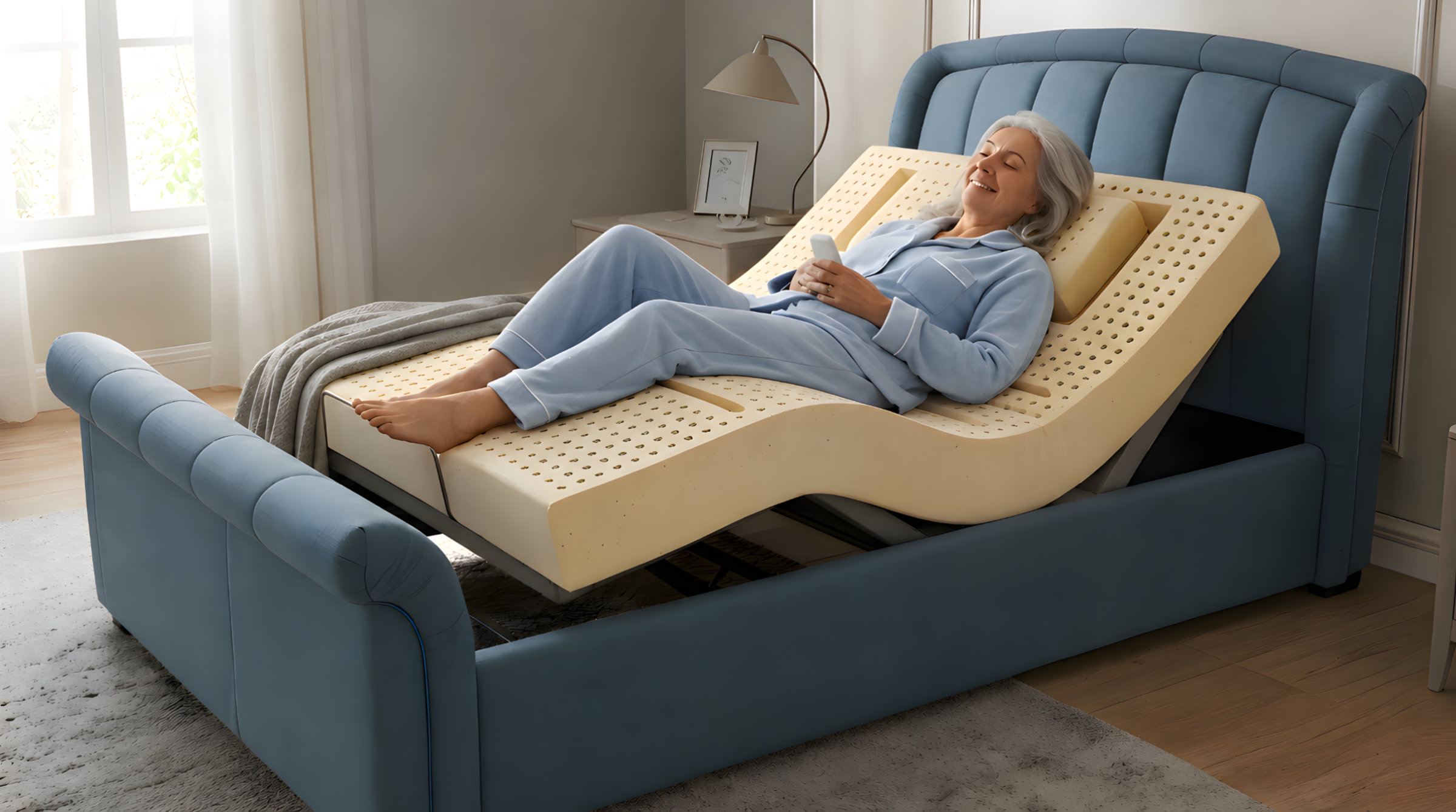
Adjustable beds can transform comfort if you read, elevate your legs, or need help finding a pain-free position. But not every mattress will flex safely, and the wrong pairing can shorten lifespan or feel lumpy within weeks.
This guide explains which constructions work, which to avoid, how thick your mattress should be, and how to check compatibility at home. We also highlight OROMED’s shoulder-recess latex design, created to maintain alignment when articulated.
If you are shopping in the UK, you will find a few practical notes on delivery, trials, and warranties at the end.
Do adjustable beds need a special mattress?
Not always, but they do need a flexible one. Adjustable bases bend at the head and knees, then return to flat. A suitable mattress must fold repeatedly without kinking, breaking its internal structure, or fighting the mechanism. In practice, that points to elastic materials and segmented spring units rather than rigid boards or glued foam stacks.
What types work best on an adjustable base?
The most reliable choices typically include:
-
100% natural latex mattresses that are single-block or zoned. Latex is naturally elastic, distributes pressure well, and bends without taking a lasting set.
-
Pocket spring mattresses with shorter, segmented coils and flexible perimeter rails. Look for thinner wire, more turns, and no border rod that prevents flex.
Latex is the standout because it combines resilience, contouring, and durability. A high quality natural latex mattress remains supportive at shallow angles, so your spine stays aligned when you elevate the backrest or knees.
Constructions to avoid
Some builds resist bending or degrade quickly when articulated:
-
Rigid board bases inside the mattress. Any hard plate or board creates a hinge point and can split foams along the edge.
-
Tall pillow-tops with thick stitched-on loft. These bunch and wrinkle when folded and can trap heat around the shoulders and hips.
-
All-in-one box springs or open coil units tied together. Linked springs fight the base and can distort permanently.
-
Mattresses with edge rods or stiff perimeter frames. These limit flex and create pressure at the knees or lower back.
If a product sheet says platform-only or shows a border rod, skip it for an adjustable.
Ideal thickness and feel
Depth matters. A 22 to 25 cm profile is the sweet spot for most adjustable setups. Thinner can feel bottomy when raised, while very thick builds resist bending and pull at seams. For feel, medium to medium-firm tends to keep alignment when sections lift. Ultra-soft options often collapse at the hips when articulated.
Will an adjustable base damage a mattress?
A compatible mattress should not be harmed by normal use. Problems arise when the mattress is too rigid, too thick, or stitched in a way that concentrates stress. Signs of trouble include new creases at the fold points, audible cracking or popping from springs, hard ridges near the knees, or fabric pulling away at the tape edge. If you notice any of these, stop articulating until you can assess the build.
How to check if your mattress will work
Before committing to a base, run a simple home test:
-
Stand the mattress on its side, then gently fold the top third toward the middle. If it curves smoothly without a hard kink or loud spring noise, that is a good sign.
-
Press along the proposed fold lines. You should feel even resistance, not a stiff bar or frame.
-
If the label lists a border rod, Bonnell springs, or a thick pillow-top, assume poor compatibility.
When in doubt, ask the maker whether the mattress is approved for adjustable use and whether warranty cover still applies.
Spotlight on OROMED’s shoulder-recess latex design
OROMED’s ORO Advanced Latex Mattress uses 100% natural latex with a patented shoulder recess that allows the shoulder to nest in the mattress rather than push the spine upward. When you raise the backrest, that recess continues to carry the shoulder without forcing the neck to tilt, which helps maintain a neutral line through the cervical and thoracic spine. The open-cell latex promotes airflow, and the 22 to 25 cm depth is optimised for smooth bending on slatted or divan-style adjustable platforms.
For buyers researching latex mattresses and orthopaedic adjustable beds that support side sleeping and pressure relief, OROMED provides details about ergonomic builds and trial terms. You can explore their range of latex mattresses or see the ORO King Size Intelligent Adjustable Bed to understand mattress-base pairing in practice.
Lifespan and maintenance
A well-matched latex or segmented pocket spring mattress on an adjustable base often lasts similar to the same mattress on a flat base. Natural latex in particular resists body impressions and recovers quickly. To protect longevity:
-
Keep angles moderate for reading or relief rather than extreme for long periods.
-
Avoid sitting on the very edge while the bed is raised.
-
Rotate head-to-toe every few months if the design allows it.
UK delivery, trial, and warranty at a glance
OROMED offers free UK delivery, a 30-night trial on mattresses and adjustable beds, and a 10-year warranty. International delivery is available on request. If you are purchasing for personal or domestic use and are chronically sick or disabled, VAT relief may apply. For details, contact OROMED directly.
Quick do and don’t checklists
Do:
-
Choose 100% natural latex or segmented pocket springs.
-
Aim for 22 to 25 cm depth and a medium to medium-firm feel.
-
Check that warranties remain valid on an adjustable base.
Do not:
-
Use box springs, rigid board inserts, or linked coil units.
-
Pick tall pillow-tops that wrinkle and trap heat.
-
Exceed thickness that hinders flex or strains seams.
FAQ
-
Do adjustable beds need a special mattress? Not necessarily, but they require a flexible build that is approved for articulation.
-
What type is best for an adjustable bed? 100% natural latex is consistently reliable, with segmented pocket springs a close second.
-
Can any mattress go on an adjustable? No. Avoid rigid, linked-coil, or thick pillow-top designs.
-
How do I know if mine will work? Look for adjustable approval, do a gentle bend test, and check for stiff frames or border rods.
-
How thick should a mattress be on an adjustable base? Typically 22 to 25 cm for smooth flex without bottoming out.
-
Can an adjustable base damage a mattress? It can if the mattress is incompatible or used at extreme angles for long periods.
-
What beds are not compatible? All-in-one box springs, open coil units, rigid board bases, and mattresses with perimeter rods.
-
Can you use your own mattress with an adjustable base? Yes, if the construction is flexible and the maker confirms suitability.
The bottom line
Adjustable comfort works best with materials that bend cleanly and rebound without stress. Natural latex and segmented pocket springs usually deliver, especially around the 22 to 25 cm mark. Watch for warning signs of incompatibility, and choose designs that maintain alignment when sections lift. If you want a purpose-built option for side sleepers, OROMED’s shoulder-recess latex mattress is engineered to stay supportive as the bed articulates. To compare specifications or arrange a 30-night trial with free UK delivery, explore OROMED’s latex mattresses or the ORO adjustable bed range.
-
Explore latex mattresses at OROMED: https://oromed.co.uk/
-
See adjustable beds designed for side sleepers: https://oromed.co.uk/oro-sleep-system/oro-king-size-intelligent-adjustable-bed